
'We believe the truth is in the middle, and that India is at an important crossroads.'

Fitch Ratings on Thursday raised India's GDP growth forecast for the current fiscal to 7.4 per cent, from 6.9 per cent, on increased consumer spending and improved sentiment boosted by GST reforms.

Investors must account for currency depreciation in their financial plans and use instruments that can cushion the erosion in purchasing power.

India, the world's fourth largest economy, is set to maintain the 'goldilocks' phase with tailwinds of good growth, low inflation and robust banking performance as well as reform initiatives poised to sustain the economic pace witnessed during 2025.

India's new national accounts will leverage new data sources and surveys to enhance the measurement of the country's informal economy, and introduce double deflation methods across sectors, replacing the current system that relies on a single deflation mechanism in Gross Domestic Product (GDP) calculations.

Trade deals ease risks for Indian equities, but weak demand and stretched valuations raise questions over whether optimism -- especially in smallcaps -- can turn into a sustained bull run, points out Debashis Basu.

The rupee fell 23 paise against the greenback to settle at a new all-time low of 91.01 (provisional) on Tuesday, weighed down by relentless foreign fund outflows, no breakthrough in India-US trade deal, and persistent US dollar buying.

While gold continues to provide safety after its strong 2025 rally, well-chosen real estate investments held with a long-term view remain attractive.
The Indian economy is likely to grow at 7.4 per cent in 2025-26, up from 6.5 per cent in the previous fiscal, mainly on account of better performance of manufacturing and services sectors, as per the government data released on Wednesday.

From the 30-Sensex firms, Bharat Electronics, Power Grid, Tata Motors Passenger Vehicles, Asian Paints, Reliance Industries, and Bajaj Finserv were among the biggest gainers. However, HCL Tech, Kotak Mahindra Bank, ICICI Bank, and Sun Pharma were the laggards.

Gold prices surged by Rs 4,000 to touch an all-time high of Rs 1,37,600 per 10 grams in the national capital on Monday, tracking firm global cues, according to the All India Sarafa Association. The precious metal of 99.9 per cent purity had closed at Rs 1,33,600 per 10 grams on Friday.

You can compound money. You cannot compound being young and stupidly in love. So? 'Don't Play Small' this Valentine's Day

Passengers may think they are just booking a ticket, but airlines' clever design tricks are quietly picking their pockets.
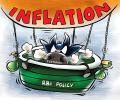
The Reserve Bank on Wednesday lowered the inflation projection for the current fiscal to 4 per cent from 4.2 per cent earlier, taking into account good agricultural output and falling crude prices.

India's services sector growth moderated in December, as the rates of expansion in incoming new work and output eased to the slowest in 11 months, and companies refrained from recruiting additional staff, a monthly survey said on Tuesday. The seasonally adjusted HSBC India Services PMI Business Activity Index fell from 59.8 in November to 58.0 in December, indicating the slowest rate of expansion since January.

Gold has emerged as the most stable asset during episodes of geopolitical stress, and crude oil has been more sensitive than others when it comes to regional conflicts and sanctions, according to a report in the Reserve Bank of India's (RBI's) monthly bulletin. Silver and the United States Treasury have showed moderate reactions.

'People become guided by emotions, fear of missing out, and greed. They tend to invest in booming sectors that may prove exceptionally expensive.' 'Typically, that represents the peak, and subsequently, they lose substantially.'

From the 30-Sensex firms, Trent, Larsen & Toubro, Reliance Industries, InterGlobe Aviation, Maruti, ITC, Adani Ports and Bharat Electronics were among the biggest laggards. In contrast, Eternal, ICICI Bank, Tech Mahindra, State Bank of India and Tata Consultancy Services were among the gainers.

Reserve Bank of India (RBI) Governor Sanjay Malhotra, and Deputy Governors Poonam Gupta, T Rabi Sankar, Swaminathan J, and S C Murmu on Friday addressed issues during the post-policy media interaction.

India's manufacturing sector activity witnessed the weakest improvement in the sector in two years in December on account of softer expansions in new orders, prompting firms to limit input purchases and job creation, a monthly survey said on Friday. The seasonally adjusted HSBC India Manufacturing Purchasing Managers' Index (PMI) -- an indicator of sector performance -- fell from 56.6 in November to 55 in December.

'In the long run, India's strong growth story and reforms to make assets globally attractive will determine the rupee's resilience.'
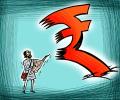
The rupee plunged 26 paise to an all-time low of 90.75 against the US dollar in intra-day trade on Monday, weighed down by uncertainty over an India-US trade deal and persistent foreign fund outflows.

Retail inflation eased to a nearly six-year low of 3.16 per cent in April mainly due to subdued prices of vegetables, fruits, pulses, and other protein-rich items, creating enough room for the Reserve Bank to go for another round of rate cut in the June monetary policy review. The Consumer Price Index (CPI) based inflation was 3.34 per cent in March and 4.83 per cent in April 2024. It was 3.15 per cent in July 2019.

While participants in the domestic financial market are expecting a 25 basis-point policy repo rate cut in the December meeting of the Monetary Policy Committee (MPC) of the Reserve Bank of India (RBI), economists remain torn between a reduction in rate cut and a pause.

Inflation data, quarterly earnings and global trends will be the major driving factors for stock markets this week, analysts said. Moreover, the trading activity of foreign investors would also influence the equity market trends.

From Rs 73k to over Rs 1.2L between January-December 2025 -- is buying gold in 2026 still sensible?

Wholesale price inflation eased to 2.05 per cent in March, as against 2.38 per cent in February, government data showed on Tuesday. The wholesale price index (WPI) based inflation, however, rose year-on-year.

'We expect modest returns in 2026 versus the steep gains seen over the past few years.'

From the Sensex firms, Tata Steel, Eternal, Tech Mahindra, Maruti, Mahindra & Mahindra, Infosys, IndusInd Bank, HCL Tech, Tata Consultancy Services and Bharti Airtel were the major gainers. Telecom operator Bharti Airtel climbed nearly 1 per cent after it posted about a five-fold jump in consolidated net profit to Rs 11,022 crore in the March 2025 quarter, mainly due to the tariff hike impact and one-time gain on tax benefits. However, Asian Paints, Tata Motors, Kotak Mahindra Bank, NTPC and Power Grid were among the laggards.
Stock markets are likely to trade in a range-bound manner in a holiday-shortened week where trading activity of foreign investors, currency movement and global macroeconomic data announcements are expected to drive sentiments, analysts said. Several global markets may see subdued activity on account of Christmas and New Year holidays, an expert said.

Fund managers advise conservative investors to cap midcap exposure at 10 to 15 per cent of their equity portfolio.

The Union Budget for 2026-27, presented by Finance Minister (FM) Nirmala Sitharaman on Sunday, which was a first, had an excellent domestic macro backdrop. According to the first advance estimates, gross domestic product (GDP) in constant prices is projected to grow 7.4 per cent in the current financial year, against 6.5 per cent in 2024-25.

Investing in gold trumped most other asset classes in terms of compounded annualised returns over the long term, suggests a report by FundsIndia.

The reduction in the goods and services tax (GST) rates has increased the momentum in India's economic activity both on the supply and demand sides, while robust agricultural activity - reflected in the strong onset of rabi sowing and adequate reservoir levels - has reinforced the outlook for food supply and rural incomes, the finance ministry said on Thursday.

Retail inflation dipped marginally to a nearly six-year low of 3.34 per cent in March due to a decline in prices of vegetables and protein-rich items. The Consumer Price Index (CPI) based inflation was 3.61 per cent in February and 4.85 per cent in March last year.

'Calibrated depreciation will help rebalance external fundamentals, offset some of the tariff differentials with competitors, improve the competitiveness of domestic substitutes vis-a-vis Chinese imports, and contribute to the easing of financial conditions at a time when the inflation rate is unusually low,' explains Sajjid Z Chinoy, head of Asia Economics at JP Morgan.

Moody's Ratings on Tuesday said tax cuts in the current fiscal has dented India's revenue growth, leaving less scope for fiscal policy support for the economy.

Budget 2026 sticks to fiscal discipline, shuns populist measures despite five key state elections coming up, but ends up rattling stock markets with a higher transaction tax on derivatives trading.

Earlier in the day, the ministry of external affairs "strongly advised" Indians to avoid travel to Iran until further notice, amid rising tensions and protests in the Islamic Republic.

India's manufacturing sector activity strengthened in October, buoyed by Goods and Services Tax relief, productivity gains and tech investment, even as international sales rose at a weaker pace, a monthly survey said on Monday.
